
Guide · 4 min read · Updated September 2026
What ceramic coating costs for a car in Florida, and what you actually get
In Palm Beach and Broward County, professional automotive ceramic coating is typically listed at $400–$1,000 for a one-to-two-year coating, roughly $1,000–$2,500 for three-to-five-year systems, and $1,500–$2,800 for seven-to-ten-year or lifetime-warranty packages. Paint correction, required before any coating, adds about $300–$1,000+ depending on condition. Vehicle size and prep hours, not the bottle, drive the price.
By Ivan Zea, owner of Zea Detailing, West Palm Beach
Key takeaways
- South Florida price pages list one-to-two-year coatings from about $400–$1,000 and five-year systems from $1,000–$2,500.
- Most shops quote paint correction separately, roughly $300–$1,000+, or include it only at the top tier.
- Nine-year and lifetime warranties are stain guarantees that require a free annual inspection and exclude scratches and chips.
- Florida ranks fourth in annual UV irradiance; summer index hits 11+, so coatings run shorter here than rated.
- The bottle is the cheapest part of the job. Correction hours and honest prep are what you're paying for.
What South Florida detailers actually charge
We price every car by quote, so the numbers here are the market, not our menu. Across the public price pages we checked in Palm Beach and Broward, an entry professional coating rated for one to two years is listed from about $400 to $1,000. Three-to-five-year systems run from roughly $1,000 to $1,700, with one Fort Lauderdale shop listing its two-layer five-year package at $2,499. Coatings marketed at seven to ten years or "lifetime" start around $1,500 and reach $2,800 on the same pages.
Every one of those figures is a starting price for a sedan or a normal SUV. A Suburban, a Raptor, or a Sprinter takes more product and more hours, and the shops say so. What the figures usually leave out matters more: on most of those pages, paint correction is either a separate line item or included only at the top tier. That is where the real spread between a $799 job and a $2,500 job lives.
Why the tiers exist, and what separates them
The tiers track the coating chemistry and how many layers go down. A one-to-two-year product is a single thin layer, often a spray-applied "lite" ceramic, and the shop's labor is mostly the wash and decontamination. Three-to-five-year systems are thicker, professional-only products applied panel by panel; one Boynton Beach shop lists six to eight hours of labor for that tier. Above that, you're paying for a base coat plus a top coat, wheels and glass coated, and a warranty registered with the manufacturer.
Turnaround on the listed Fort Lauderdale packages is one to two days for the entry tier and two to three days for the multi-layer ones. Read that as a signal. A coating installed in an afternoon in a parking lot was not corrected first, and it will not behave like the same bottle installed over paint that spent a day under inspection lighting.
Prep is most of the bill
A ceramic coating is glass-hard once cured, and it seals in whatever is under it. Swirls, water etching, and holograms from the last dealer wash become permanent until the coating is polished off. That is why every ceramic coating we install starts with full decontamination and paint correction, and why the market add-on for correction runs roughly $300 to $1,000 or more depending on condition, per a published Florida pricing guide.
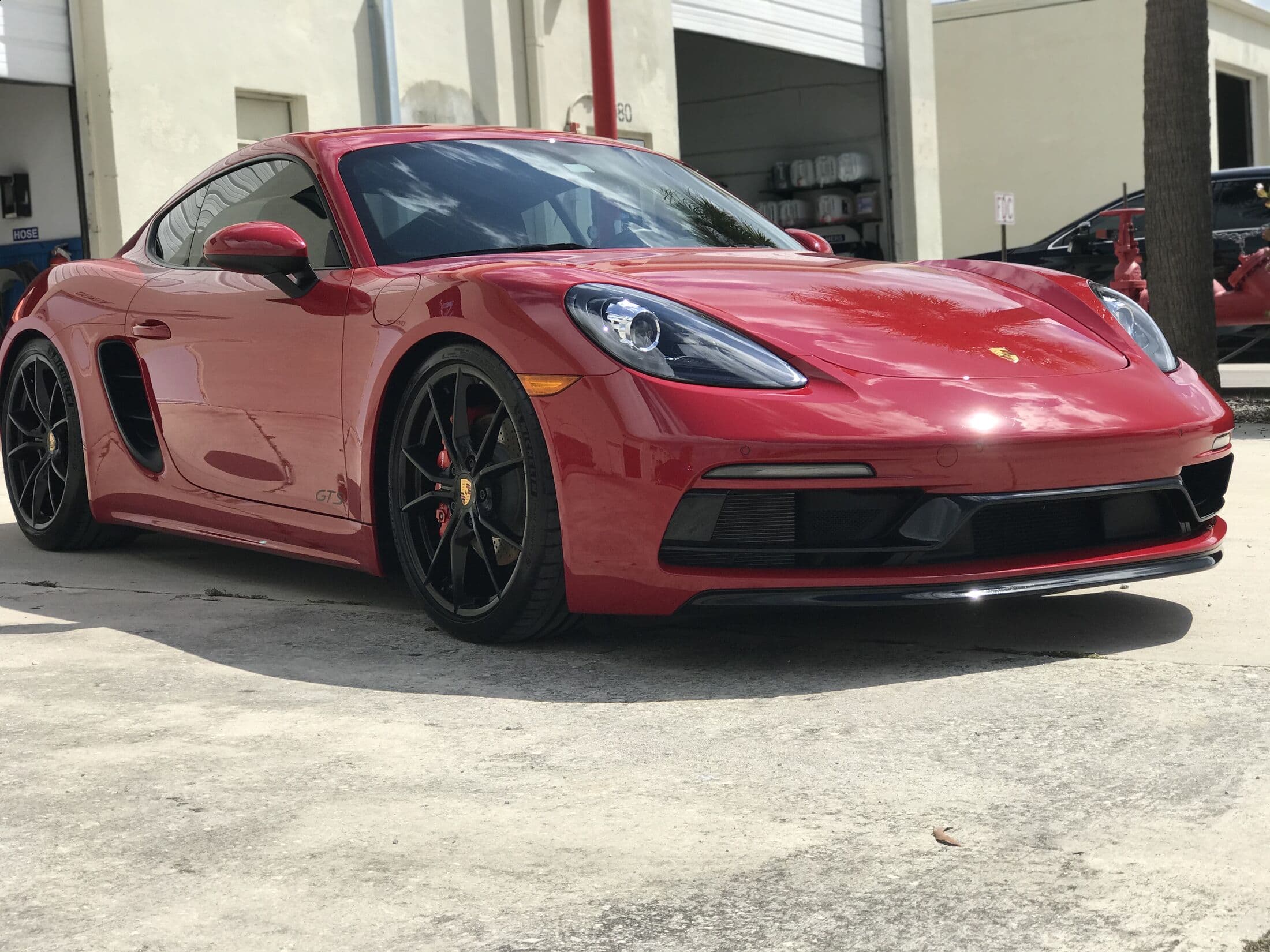
This is also where an exotic and a daily driver diverge. A Ferrari or a Porsche has thin, expensive clear coat and often a repainted panel or two; our paint correction on those cars is test-spot first, measured, and conservative, and it takes longer. A Tahoe that lives outside in Wellington usually needs a harder cut and less finesse. Same coating on both cars, very different bills, and an honest quote reflects that.
What a 9-year or lifetime warranty really means
Manufacturer guarantees are narrower than the marketing. Gtechniq's published terms cover its coatings for five, seven, or nine years against staining and discoloration, provided you return to the installing accredited detailer every 12 months for a free inspection. Excluded: scratches, abrasions, stone chips, chemical damage, and anything applied over the coating. Ceramic Pro's terms are similar: a lifetime warranty requires annual inspections and becomes a five-year warranty from the last inspection if one is missed. Swirl marks, chips, and brush-wash damage are excluded there too.
So a "lifetime" coating is a stain guarantee with an annual appointment attached, not a force field. That's fine; it is what a coating is. Buy the tier that matches how long you'll own the car and how you'll wash it, not the biggest number on the card.
Florida is harder on a coating than the box says
Florida ranks fourth among U.S. states for annual UV irradiance, behind Arizona, New Mexico, and Hawaii, and the summer index here runs 9 to 11+ from June through August. Add salt air on A1A and Flagler Drive, reclaimed-water sprinklers, lovebug season, and afternoon storms that bake dry on a hot hood. One South Florida shop's own guide rates its "5-year" flagship at three to five years here. We'd agree. A coating in a Jupiter driveway works harder than the same coating in Ohio.
Maintenance is what closes that gap. Ceramic Pro's aftercare guide asks for no washing for two weeks after install, a wash every two weeks after that, a proper two-bucket hand wash at least every 60 days, and no brush car washes. That matches what we tell clients. A coated car that gets a coating-safe wash on a schedule stays hydrophobic for years; one that goes through the tunnel wash on Okeechobee loses it in a season.
FAQ
How long does a ceramic coating actually last on a car in South Florida?
Shorter than the rating on the box. Florida UV and salt deplete the hydrophobic layer faster than temperate climates, so a coating sold as five years realistically delivers three to five here with proper washing, and less if it goes through brush car washes or sits under sprinklers.
Can I coat over swirl marks and fix them later?
No. The coating seals defects in; fixing them later means polishing the coating off and starting over. Correction first is the whole point, which is why we treat prep as the job and the coating as the finish.
Does a ceramic coating stop rock chips and scratches?
No. Manufacturer warranties from Gtechniq and Ceramic Pro explicitly exclude scratches, abrasions, and stone chips. A coating resists UV, salt, staining, and light marring, and makes washing easier. For chip protection on a front end, that is paint protection film.
Is a ceramic coating worth it on a daily driver, or only on an exotic?
Both, for different reasons. On a daily driver it cuts wash time and stops UV chalking on a car that lives outside. On an exotic it protects thin clear coat and preserves corrected paint. The tier and prep level should match the car and how long you'll keep it.
Sources
- Fort Lauderdale price page lists Opti-Coat packages from $400 (2-year warranty), $1,000 (5-year), $1,500 (7-year), and $2,800 (10-year/lifetime); paint correction is assessed on site and quoted separately; pricing depends on vehicle size. — luxewashdetailing.com
- Boynton Beach price list: $799 (2-year Gyeon), $1,299 (3-year Gtechniq), $1,599 (5-year Symplex); approximately 6 to 8 hours of labor; machine paint correction included only in the 5-year tier; larger vehicles quoted at booking. — www.dshinedetails.com
- Fort Lauderdale shop lists $999 (1-year, no correction, 1-2 day turnaround), $1,699 (3-year, 2-3 days), and $2,499 (5-year, double application base plus top coat, wheels and glass coated, 2-3 days). — www.detailgeeks.com
- Florida pricing guide: entry professional $500–$800 (1–2 years), mid-tier $800–$1,300 (3–5 years), premium $1,500–$2,500+ (5–9+ years); paint correction adds $300–$1,000+; larger vehicles cost more within a tier. — luxewashdetailing.com
- South Florida shop's buyer's guide rates a 5-year flagship coating at a realistic 3–5 year lifespan locally because UV depletes the hydrophobic layer faster than temperate climates; no coating hits rated life without annual maintenance. — www.dshinedetails.com
- Gtechniq guarantee terms: C1 5 years, Crystal Serum 7 years, Crystal Serum Ultra 9 years, guaranteed against staining and discoloration; free inspection at the installing accredited detailer every 12 months required; excludes scratches, abrasions, stone chipping, chemical damage, and other coatings applied over it. — registerautodetail.com
- Ceramic Pro aftercare and warranty: do not wash for two weeks after delivery; wash every two weeks; two-bucket hand wash at least every 60 days; avoid automatic brush washes; lifetime warranty requires annual inspections and becomes a 5-year warranty from the last inspection if one is missed; excludes swirl marks, scratches, chips, and wash-brush damage. — ceramicpro.com
- Florida ranks 4th among U.S. states for annual average daily UV irradiance (4,596 J/m²) behind Arizona, New Mexico, and Hawaii, per CDC Environmental Public Health Tracking data. — worldpopulationreview.com
- Florida summer UV index: June 9–11+, July 11+ (Extreme), August 9–11. — www.essuntials.com