
Boats · Restoration
From chalky to mirror — without repainting
Multi-stage wet compounding and polishing that removes oxidation, haze, and dock rash and brings back the gloss the builder intended.
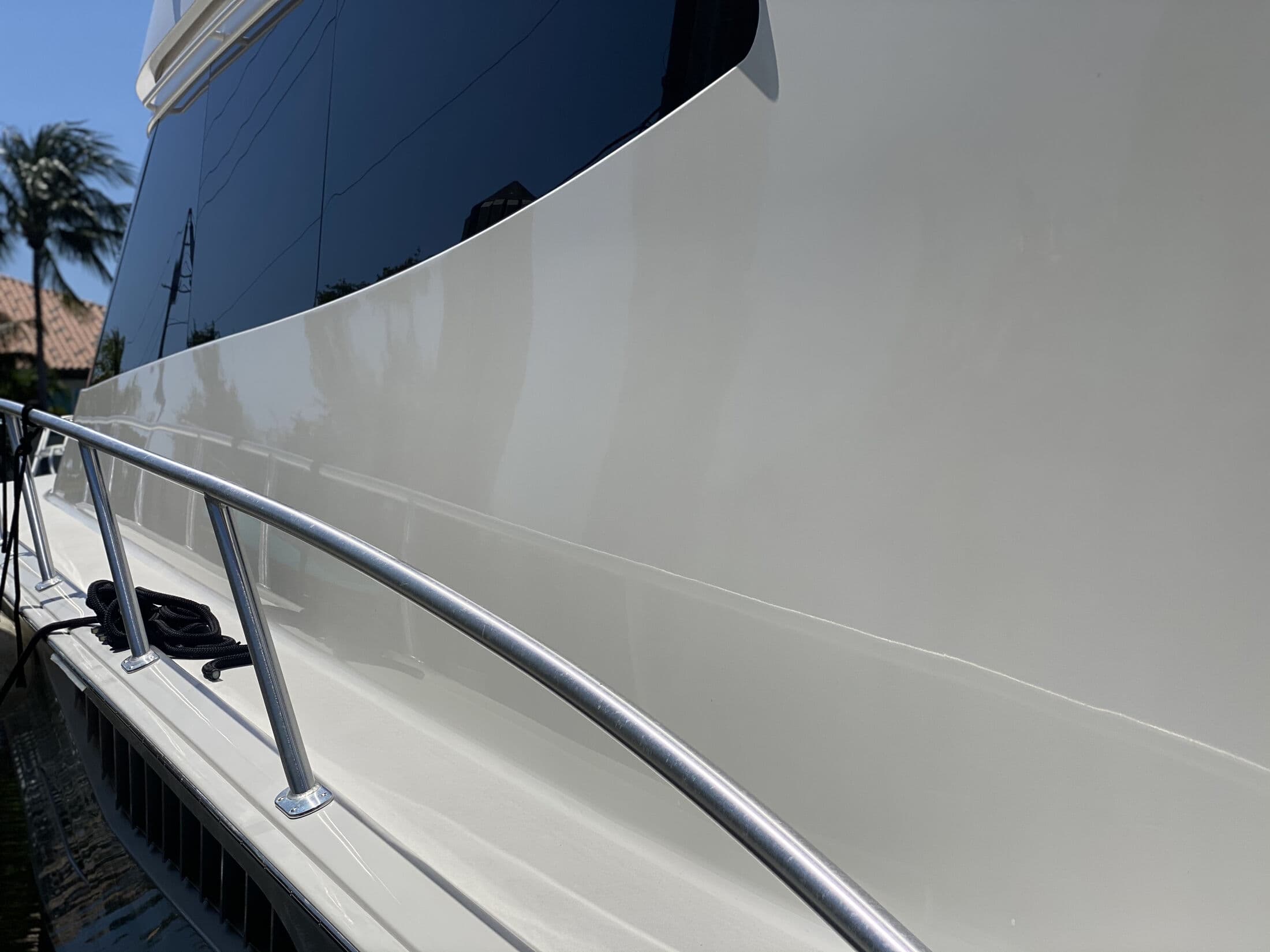
What it is: Gelcoat correction is the machine compounding and polishing of a boat's fiberglass gelcoat to remove the oxidized, chalky top layer and restore true color and gloss. Done properly it makes most faded hulls look new again and avoids the cost of painting.
Scope: Hull sides, topsides, decks, hardtops, and towers on boats from 20 to 100+ feet — in the water, on a lift, on a trailer, or in the yard.
Oxidation doesn't mean your boat needs paint — it means the gelcoat needs to be professionally cut and refined. Our multi-stage correction removes the dead, chalky layer, restores true color and depth, then locks the result in with protection so it doesn't slide backwards. Ivan has restored everything from 25-foot Whalers to a 54-foot motor yacht he's maintained for three seasons.
What oxidation actually is
Gelcoat is porous. Under Florida UV, its surface slowly breaks down into a chalky, dull layer — first losing gloss, then color. Wiping wax over it hides the problem for a few weeks; it doesn't fix it. Correction removes the degraded layer entirely, exposing fresh gelcoat underneath.
The same discipline applies to painted hulls (Awlgrip, Alexseal): measured, deliberate machine work that removes swirl marks, water spotting, and buffer trails a previous crew may have left — without burning through what's left.
Measured, staged, verified
Every correction starts with an honest assessment: how much healthy gelcoat is there to work with, and what result can it support. We stage the work — heavy cut, refining polish, finishing polish — checking progress under inspection lighting at each stage.
We document condition before we start and photograph the result when we're done — the before-and-afters in our gallery are real jobs on real client boats.
The process
How gelcoat correction gets done right
- 01
Condition assessment
We evaluate oxidation depth and gelcoat thickness before recommending a cut level.
- 02
Wash & decontamination
Salt, scum, and bonded contamination off first — you can't polish dirt.
- 03
Wet compounding
Heavy-cut stage removes the oxidized layer and deep defects.
- 04
Refinement polish
Progressively finer stages restore clarity, depth, and true color.
- 05
Protection
Sealant or ceramic coating locks in the result — corrected gelcoat left bare re-oxidizes fast.
Gelcoat Correction FAQ
Good questions
How much does gelcoat correction cost?
$20 per linear foot topsides and $15 per foot hull sides, charged per step. Most boats need two to three steps, so a 42-foot hull runs about $2,940 for two steps and $4,410 for three. We confirm the step count after seeing the hull, and protection is included on the final pass.
My hull is chalky white — is it too far gone?
Usually not. Heavy oxidation looks terminal but most gelcoat has enough depth for a full restoration. We assess first and tell you honestly what the surface will support. The transformations in our gallery started exactly where your boat is now.
How long does gelcoat restoration last?
The correction itself is permanent — that oxidized layer is gone. How long the gloss holds depends on protection: sealed and maintained, years; left bare in Florida sun, oxidation begins creeping back within months. That's why protection is built into every restoration we do.
Can you correct my boat in the water?
Yes, hull sides down to the waterline, topsides, decks and towers are all done in-slip. Full below-waterline work needs the boat on a lift, trailer, or hauled — we'll tell you which makes sense for your goal.
Can you remove swirl marks another detailer left?
Yes. Buffer trails, holograms, and swirl from previous work are among the most common defects we correct — on gelcoat and on painted hulls.
Send us photos of the condition
Photos of the current condition get you the fastest, most accurate quote.
Where we do it
Gelcoat Correction across Palm Beach & Broward
- Gelcoat Correction in Hollywood
- Gelcoat Correction in Dania Beach
- Gelcoat Correction in Fort Lauderdale
- Gelcoat Correction in Pompano Beach
- Gelcoat Correction in Lighthouse Point
- Gelcoat Correction in Boca Raton
- Gelcoat Correction in Highland Beach
- Gelcoat Correction in Delray Beach
- Gelcoat Correction in Manalapan
- Gelcoat Correction in Singer Island
- Gelcoat Correction in Palm Beach
- Gelcoat Correction in West Palm
- Gelcoat Correction in PB Gardens
- Gelcoat Correction in Jupiter
Pairs well with