
Guide · 6 min read · Updated September 2026
Detailing a boat before you sell it: what surveyors and buyers notice
Detail the boat before listing photos are shot and refresh it lightly the day before the survey. Surveyors and buyers read the engine room and bilge first, then the waterline, non-skid, upholstery, and stainless. Florida detailers list wash-and-wax at roughly $8–$15 per foot, compounding and polishing at $15–$35, and full restoration packages up to about $55 per foot; a corrected, dry, odor-free boat photographs better and shortens negotiation.
By Ivan Zea, owner of Zea Detailing, West Palm Beach
Key takeaways
- Surveyors open the engine hatch first; a dry, white bilge lets them see maintenance instead of assuming neglect.
- Waterline tannin, chalky gelcoat, and grey non-skid show in listing photos and get priced into the first offer.
- Upholstery mildew, stainless rust bleed, and odor are what buyers touch and remember once aboard.
- Correct and protect at least a week before photos; refresh lightly the day before the survey, never a heavy degrease.
- South Florida price pages list wash-and-wax at roughly $8–$15/ft and compound-and-polish at $15–$35/ft; full restoration packages run to about $55/ft.
What a surveyor reads in the first ten minutes
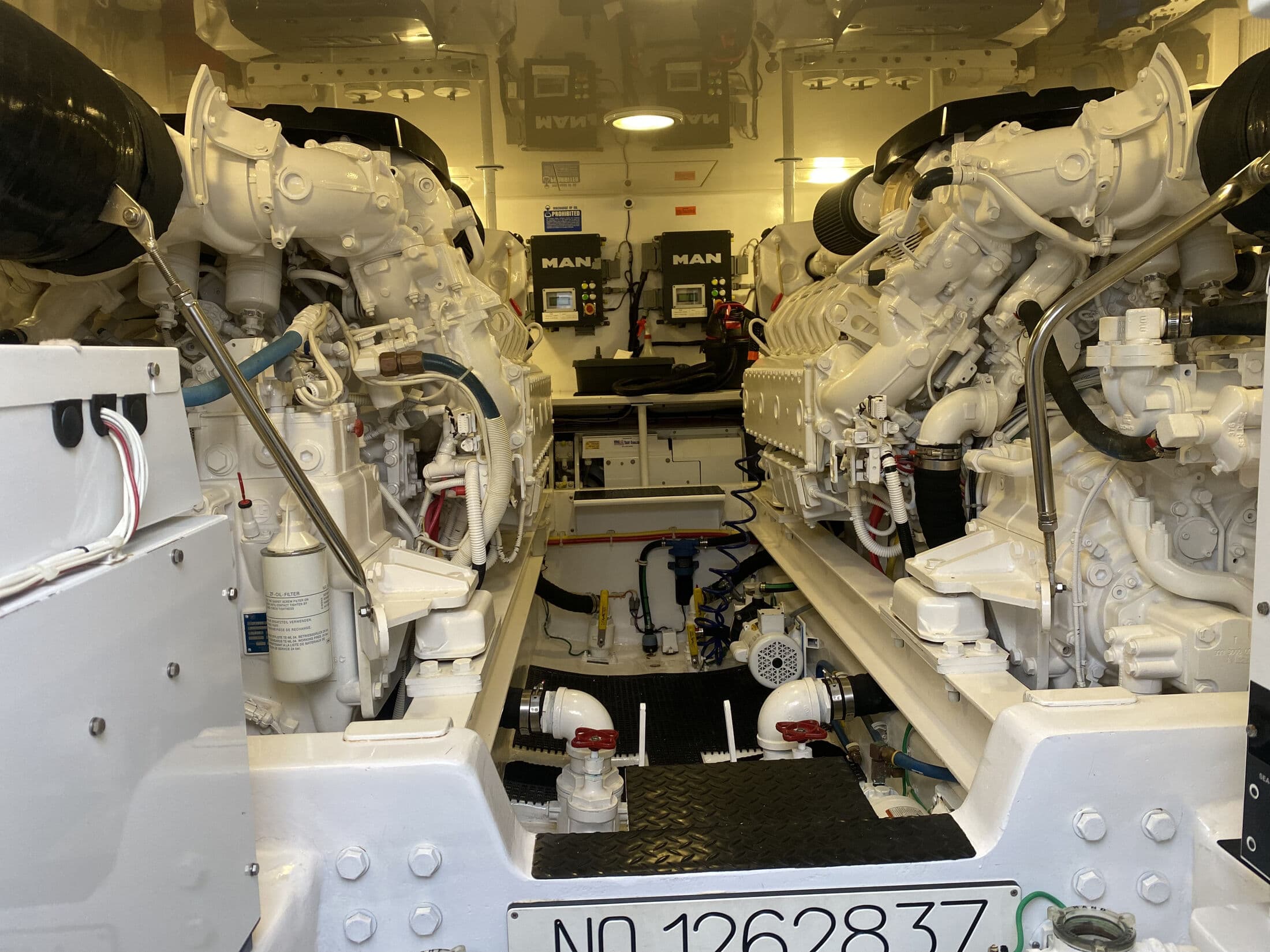
A surveyor opens the engine hatch before they look at the hull sides, because that's where the money is. The bilge and engine pan get inspected for any sign of a leak, and a standard move is laying clean white absorbent pads under the engines before the sea trial so every drip has a witness. Breaks in the engine's paint get read as prior repairs or skipped service. Belts get checked for dust that means misalignment; hoses get squeezed for the crunch that means they're failing. None of that is cosmetic, and none of it hides under degreaser.
Cleanliness still matters, because it changes what the surveyor can see. An oil-filmed bilge hides where a drip started and turns a loose hose clamp into a "possible raw-water leak, investigate further" line in the report. A white engine room shows a dry pan, clean bonding connections, and a fresh oil change from across the hatch. The bonding system on almost any boat that isn't new has some deterioration; a clean bilge lets the surveyor see how little instead of assuming how much.
Engine room and bilge work is part of our interior and brightwork detailing: degrease, rinse, dry, treat the surface rust on brackets and clamps, wipe the engines down, and leave the space looking like it belongs to an owner who kept records. If there's a drip, a dry white bilge will show it, and you'll see it before the surveyor does. That's the point.
Waterline, gelcoat, and non-skid: what buyers see from the dock
From the dock, the first thing a buyer sees is the waterline. On this coast that's usually a tan-to-brown tannin line, and the boats that wear it worst live near river mouths: the Loxahatchee in Jupiter, the St. Lucie, and the darker stretches of the Intracoastal after summer rain. Tannin bonds to gelcoat and darkens the longer it sits. It comes off with an oxalic-acid cleaner worked in short sections and rinsed hard, and a wax or polymer sealant over the hull sides afterward keeps it from coming straight back. On painted hulls, acid is a last resort, and we'd rather say so than learn it on your topsides.
Above the waterline, the question is oxidation. Miami's June UV index averages 12.5, with extreme readings running from spring into fall, and Palm Beach sits under the same sun. Gelcoat that has lived uncovered for a few seasons reads chalky in listing photos even when it passes at the dock, and buyers price it into the first offer. Gelcoat correction removes the dead layer and restores color and depth. It is not a wax job, and the photos show the difference immediately.
Non-skid gets overlooked by sellers and never by buyers, because it's what they're standing on. Grey, stained diamond pattern and dirty SeaDek say nobody cleaned the boat between trips. A proper non-skid scrub, followed by a non-slip protectant rather than wax, brings the deck back to white without making it slick, which is the one thing a surveyor will absolutely write down.
Upholstery, brightwork, and the things a buyer touches
Once aboard, buyers stop looking and start touching: helm seats, bolsters, the forward sunpad, cabin cushions. Marine vinyl in South Florida gets mildew in the stitching and pink staining that sellers scrub at and make worse. The fix is a proper deep clean, then a UV conditioner that leaves the vinyl matte and dry, not glossy. Sellers' guides put it plainly: shampoo the upholstery, clean every cushion, remove the mildew, because small problems become big question marks in a buyer's mind.
Stainless tells the same story. Rust bleed on rail bases, tower legs, and rod holders reads as salt sitting on the boat for months. Machine polishing brings it back to a true mirror, and a corrosion inhibitor holds it through the showing period. Teak should be cleaned and brightened, not sanded to raw wood a week before the survey. Isinglass should be clear, not hazed; a buyer who can't see out of the cockpit assumes the enclosure needs replacing. And the boat should smell like nothing. Heads, bilge, and lockers hold odor that no photo can fix and every showing will find.
When to detail: photos first, survey second
Order matters. Correction and protection first, at least a week before listing photography, so the finish has cured and any tower or hardtop work is done. Then shoot on an overcast morning or in open shade; harsh sun blows out fiberglass and buries the cockpit in shadow. Brokers are direct about it: most buyers begin online, first impressions decide who calls, and a staged, well-lit boat draws more interest than the same boat shot on a trailer at noon.
Between listing and survey, keep the boat on a maintenance washdown so it shows in week six the way it did in the photos. The day before the survey and sea trial: a light interior refresh, a dry bilge, clean white pads under the engines. Not a heavy degrease the night before. A surveyor who smells fresh solvent in the engine room wonders what it was covering.
Where the boat lives changes the plan. A dry-stacked center console in Jupiter or North Palm Beach mostly needs waterline, non-skid, and upholstery. A sportfish in a wet slip at Palm Harbor, Old Port Cove, or Bahia Mar needs hull sides and the tannin line handled in-slip to the waterline, with anything below it scheduled around the survey haul-out at Lauderdale Marine Center or Safe Harbor Rybovich.
What it costs and what it returns
Florida price pages give a fair picture of the market. A wash and wax runs roughly $8–$15 per foot in one South Florida cost guide, and compounding and polishing is listed at $15–$35 per foot in the same guide. A Miami detailer lists a single-stage compound-and-wax package from $22 per foot and a two-stage restoration with ceramic coating from $55, and a Daytona shop's price list runs one-step correction from $40 per foot and two-step from $55. Most pages carry the same footnote we would: heavy oxidation, tower and hardtop access, and layout move the number after inspection. We quote after seeing the boat for the same reason.
We couldn't find a reliable return-on-detailing statistic, and we won't invent one. What brokers do say is that they have watched sellers lose thousands by skipping a few prep items, and that a spotless boat signals it was cared for. On a 40-foot boat, compounding and polishing at the South Florida guide's $15–$35-per-foot range is roughly $600–$1,400. Against the first counteroffer on a boat that photographs chalky, that is a small number. A dry engine room and a corrected hull give the surveyor less to write and the buyer less to negotiate with. That's the return.
FAQ
Should I detail the boat before or after the survey?
Before, and specifically before listing photos. The survey is where a clean, dry engine room pays off, but the photos are what get a buyer to book the survey in the first place. Do correction a week or more ahead of the shoot, then a light refresh the day before the surveyor arrives.
Will a spotless engine room make a surveyor suspicious?
Not if clean is the boat's normal state and the maintenance records back it up. What raises eyebrows is the smell of fresh solvent the morning of the survey, or absorbent pads that are new but the pan around them is stained. Detail early, keep it dry, and let the surveyor see the boat as it really lives.
How far ahead of listing photos should I book the detail?
At least a week for gelcoat correction, sealant, or coating, so everything cures and any brightwork or non-skid work is finished. Then a maintenance wash within a day or two of the shoot so the boat is dry, streak-free, and staged. Shoot in soft light, not midday sun.
Is ceramic coating worth it on a boat I'm about to sell?
For a quick sale, usually not. Correction plus a polymer sealant gives you the photos and the showing. If the boat may sit on the market through a South Florida summer, a coating keeps it showing consistently between washdowns and is a real line in the listing. We'll tell you which makes sense for the boat and the timeline.
Sources
- Engine surveys inspect the bilge and engine pan for leaks and place clean white absorbent pads there for the trial run; breaks in the engine's paint finish point to prior repairs or skipped service; belt dust indicates misalignment; crunchy hoses signal impending failure — passagemaker.com
- Nearly every boat that is not very new has some level of deterioration in the bonding system; bilge and bonding connections are among the most overlooked surveyor inspection points — sailing-blog.nauticed.org
- BoatUS buyer checklist rates hull finish, deck/cabin, upholstery, molding/trim, bilge pumps, engine and steering, and notes it is not a substitute for a marine surveyor and engine mechanic — www.boatus.com
- Miami's highest-average UV month is June at 12.5; peak recorded 13.41 on June 6, 2016; in 2022 seven months (March–September) reached extreme UV levels — www.uvindextoday.com
- Waterline tannin staining is removed with oxalic-acid-based cleaners worked in small sections and rinsed; a coat of wax or polymer sealer minimizes brown stains; acid should be avoided or used as a last resort on painted hulls — marinehowto.com
- Seller checklist: clean the bilge and remove standing water and odor, wipe down the engine compartment, shampoo upholstery and remove mildew; small problems become big question marks; 'we've watched sellers lose thousands simply because they skipped a few prep items'; shoot photos on an overcast day or in soft morning light — yachtingexperts.com
- Broker guidance: buyers notice the small things and a spotless boat suggests it was well cared for; most buyers begin online and first impressions matter; stage the boat for well-lit photos from multiple angles — rcryachts.com
- Pre-sale detailing scope: exterior wash, waterline cleaning, oxidation removal, polishing, stainless maintenance, interior cleaning of galleys, heads and upholstery, and staging cockpit and cushions before listing photos — www.nauticaldetails.com
- South Florida regional cost guide: basic wash and wax $8–$15/ft, compound and polish $15–$35/ft, full detail $20–$55/ft; basis for the $600–$1,400 estimate on a 40-foot boat — boatwork.co
- Daytona Beach / Volusia County (Central Florida) detailer price page: Basic Wash from $3.50/ft, Superior Wash & Wax from $24/ft, 1-Step Correction from $40/ft, 2-Step Correction from $55/ft; heavy oxidation, layout complexity and access adjust final pricing after evaluation — www.floridagoldcoastdetailing.com
- Miami detailer price page: Maintenance Wash $8/ft, Premium Detail with single-stage gelcoat compound and wax $22/ft, Full Restoration with two-stage oxidation reversal and ceramic coating $55/ft — www.alesmobiledetailing.com