
Guide · 6 min read · Updated September 2026
Gelcoat oxidation removal: when your chalky hull can be saved
Usually, yes. Gelcoat oxidation is the UV-degraded surface of the resin, a thin dead layer on a coat that left the factory 15–25 mils thick. Light through heavy chalking comes back with staged wet compounding and polishing; severe chalk needs a 600–800 grit wet sand first. Only gouged, crazed, or burned-through gelcoat needs paint or re-gel.
By Ivan Zea, owner of Zea Detailing, West Palm Beach
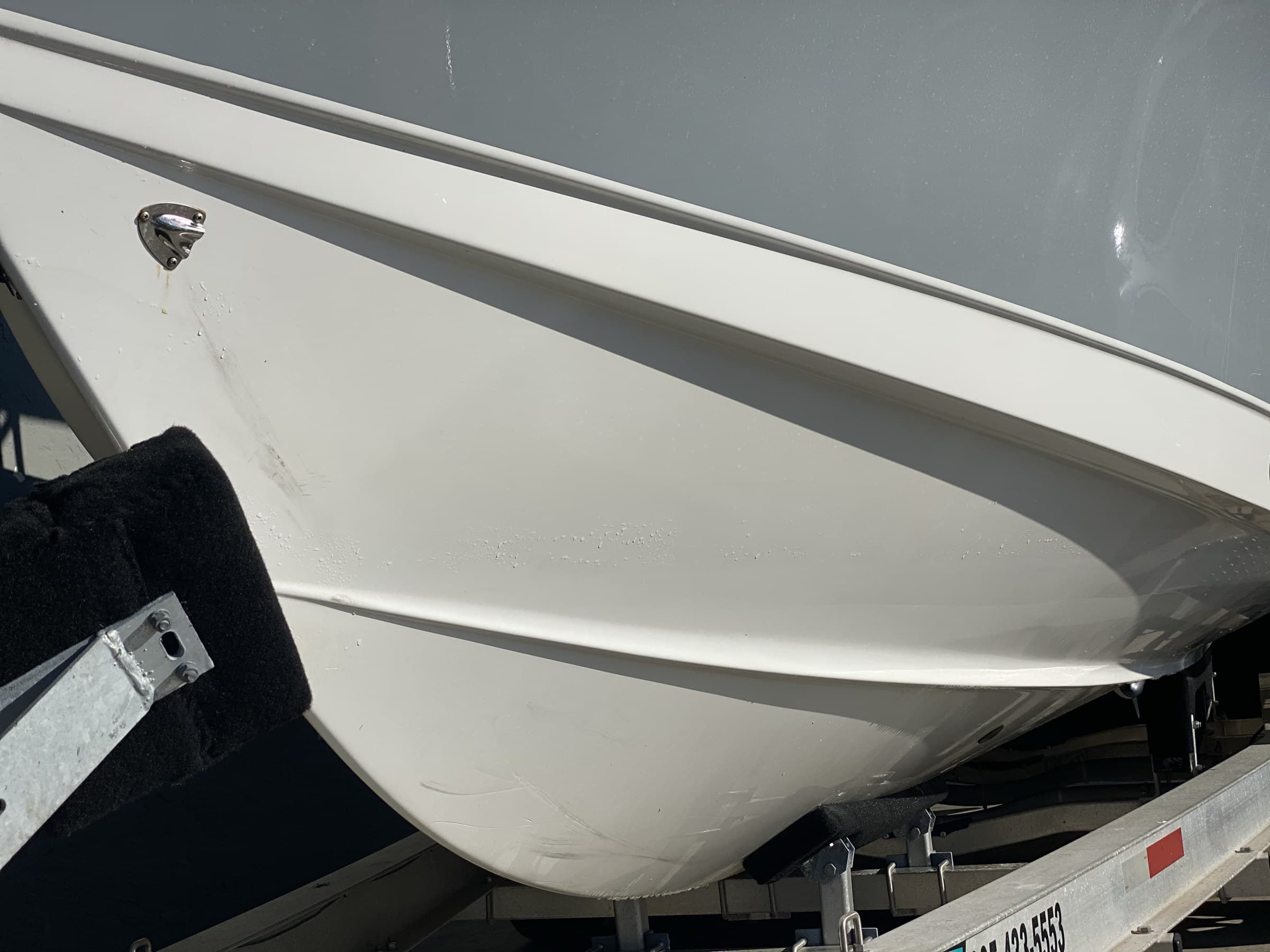
Key takeaways
- Oxidation is UV-killed resin on the surface; the water test shows whether color is still underneath.
- Gelcoat thickness, not chalk depth, decides the outcome; edges, chines, and corners are always thinnest.
- Light to heavy chalk comes back with staged wet compounding; severe chalk needs 600–800 grit wet sanding first.
- Paint only when gelcoat is gouged, crazed, or worn through; owner-reported spray quotes ran $150–$250 per foot as of 2017.
- Published South Florida compounding rates run about $30–$75 per foot; Zea quotes from photos and length.
- Corrected gelcoat left bare re-oxidizes within months; sealant or ceramic plus fresh-water rinses hold the result.
What gelcoat oxidation actually is, and why Florida accelerates it
Gelcoat is the pigmented polyester resin skin sprayed into the mold before the fiberglass goes in. It is not paint. It is a porous layer, roughly 15–25 mils thick, that left the factory glossy because it was smooth. Ultraviolet light breaks the resin down at the surface, the binder goes, and the pigment is left exposed as a chalky powder. That powder scatters light, which is why a Whaler that used to read bright white now reads flat grey, and a navy hull reads purple.
Palm Beach and Broward peak at a UV index of 11, rated Extreme, from April through August, and December still averages High. A boat in an uncovered slip at Sailfish Marina or on an open rack in Jupiter takes that on the topsides and the sunny side of the hull every day. Salt spray dries into crystals that hold moisture and heat against the surface. On unprotected gelcoat we see oxidation start inside a single summer.
The quick check is the water test. Splash a handful of water on the dull area. If the color jumps back toward what it should be while wet and fades as it dries, the pigment is still there and the surface is oxidized, not stained. That is good news, because oxidation is a surface condition. It is also the hull showing you what it will look like once the dead layer is gone.
How to read the stages of a chalky hull
Run a dry hand along the hull side, above the waterline and away from anything that shaded it. Light oxidation leaves a faint white residue on your fingers; the hull has lost its wet look but still reflects. Moderate oxidation transfers chalk with light pressure, and the color is clearly lighter than the protected strip under the rub rail. Heavy oxidation leaves a clear white trail.
Beyond that are two stages that matter for the decision. Severe oxidation is where the chalk is thick enough to write your name in, and compounding alone will not cut through the dead layer; wet sanding has to come first. Gelcoat failure is where the surface is crazed, porous, or worn to the laminate, and no abrasive brings it back. Most Florida hulls we assess, including ones that look terminal from the dock, sit at moderate or heavy and come back.
What decides it is thickness. Builders target 18–20 mils on flat panels, but a measured hull can carry 22 mils on the side and only 12 at the gunwale edge. Bow, chines, corners, and hardtop edges are always thinnest, which is where a previous crew's burn-through usually shows. A correction pass removes only a mil or so of material, so the question is never whether the chalk can be removed. It is how much healthy gelcoat is left underneath to polish.
Wet compounding or paint: how the decision gets made
The rule is least aggressive first. We test a spot with a medium compound and a wool pad, wet, on the worst panel. If it clears and holds gloss under inspection light, that is the process. If it hazes without cutting, we step up to a heavy cut, and only chalk that still will not move gets a 600–800 grit wet sand, finished at 1500 so the scratch buffs out cleanly. Every stage is checked before the next one starts.
Paint is the answer when the gelcoat is deeply scratched, gouged, or reading thin, or when a prior crew already sanded through at the edges. A sprayed two-part polyurethane like Awlgrip or Alexseal is a beautiful finish, but it is a yard job: haul, fair, prime, spray, and weeks out of the water. Owner-reported yard quotes for an Awlgrip hull spray were already running $150 to $250 per foot back in 2017, and most of that number is prep, not paint; expect more today.
Correction is a fraction of that. Published South Florida rates for light-oxidation polish and wax run around $30 per foot, a compound-and-polish correction with wax about $50 per foot, and compounding for heavier oxidation is listed as high as $75 per foot. Our gelcoat correction work is quoted from photos and length rather than a menu, because a 26-foot trailer boat with one chalky side and a 60-foot sportfish that has been bare for three seasons are not the same job.
What correction can and cannot fix
Compounding removes anything that lives in the oxidized layer: chalk, haze, UV fade, water spotting, buffer trails and holograms from a previous detailer, light dock rash, and the tea-colored waterline stain that comes off a run up the Loxahatchee. That tannin stain is chemistry, not oxidation. An oxalic-acid hull cleaner lifts it before any pad touches the boat, and we never use gritty household cleaners on gelcoat, because the shiny outer layer is thin and abrasives take it off with the stain.
It cannot fix stress cracks, spider crazing, gouges you can catch a fingernail in, or panels where the pigment itself is gone; if the water test does not darken the color, there is no color left to expose. It cannot put material back where an aggressive buffer took a gunwale to fiberglass. Those spots need gelcoat repair or paint, and we say so on the assessment rather than polishing around them.
There is a middle case we see on older Bertram, Hatteras, and Sea Ray hulls from Lighthouse Point to North Palm Beach: a hull compounded every spring for fifteen years. The chalk comes off, but each pass took material with it, and there is not enough left for another heavy cut. That hull gets a gentle single-step and a coating to stop the cycle, or it gets paint. Honest measurement up front is the difference.
Protecting the result so it does not slide backwards
Corrected gelcoat left bare in this sun starts re-oxidizing within months. Every restoration we do ends with protection, and the choice depends on how the boat lives. A polymer sealant is the minimum and buys a few months with regular rinsing. A marine ceramic coating over the corrected surface is what we recommend for anything kept in an uncovered slip or on a rack; it turns salt and waterline scum into a rinse instead of a scrub and lasts years rather than weeks.
Then it comes down to water. A fresh-water washdown after every salt run, before the crystals dry hard, does more for gloss than anything you can buy in a bottle. Boats in dry stacks at Jupiter or on covered lifts hold a correction longest; in-water boats at Old Port Cove or Bahia Mar on a weekly or bi-weekly wash program hold it nearly as well. The boats that come back to us chalky in two years are the ones nobody rinsed.
FAQ
Can I just wax over an oxidized hull?
You can, and it will look better for a few weeks. Wax fills the chalky surface and adds gloss, then washes out, and the dead layer is still there underneath. Correction removes that layer; wax or a coating then protects fresh gelcoat instead of hiding dead gelcoat.
Does compounding thin my gelcoat?
Yes, a little with every pass, which is why we start with the least aggressive step that works and check under inspection light before going heavier. A hull that has been compounded hard every spring for a decade may be near the end of its material, and we will tell you before we start.
Will the oxidation come back after correction?
The layer we removed is gone for good. What comes back is new oxidation on bare gelcoat, and in Palm Beach and Broward that starts within months if the surface is left unprotected. Sealant or ceramic coating plus fresh-water rinses is what keeps a corrected hull looking corrected.
Can you correct oxidation with the boat in the water?
Yes. Hull sides down to the waterline, topsides, hardtops, and towers are all done in the slip. Full below-waterline work needs the boat on a lift, a trailer, or hauled, and we will tell you which makes sense for the result you want.
Sources
- Gelcoat thickness typically ranges from 15 to 25 mils; quality builders target 18–20 mils; a measured hull carried 22 mils on the sides and 12 mils at the gunwale edges; curves and corners run thinner; aggressive sanding can burn through to fiberglass. — catalystmarineservices.com
- Gelcoat is thinnest at the bow, corners, and curves; start with the least aggressive approach; wet sand with 600–800 grit and finish at 1500; deeply scratched, gouged, or thin gelcoat may need sanding and paint; follow compounds with polish and wax for protection. — www.practical-sailor.com
- Oxidation stages by hand test (faint residue, chalk with light pressure, clear white trail for heavy, thick enough to write your name in for severe); the water test darkens oxidized color; severe oxidation needs wet sanding when compounding alone will not cut; gelcoat failure needs re-gelcoating rather than compounds. — augustrace.us
- Palm Beach and Fort Lauderdale UV index peaks at 11 (Extreme) from April through August and sits at High (6) in December. — www.essuntials.com
- West Palm Beach climatology: average monthly UV index is 5 in January and February and 6–7 from March through November, so the coast sits at High for most of the year. — www.weather-us.com
- Brown waterline stains come from natural tannin in rivers and brackish estuaries; oxalic and phosphoric acids dissolve them; gritty abrasive cleaners can damage the thin shiny outer layer of gelcoat. — www.practical-sailor.com
- The Loxahatchee River is a tannin-stained channel whose forks meet and flow to the Atlantic through the Jupiter Inlet. — www.waterfront-properties.com
- South Florida (Palm Beach County) published pricing: Wash + Polish & Wax with light oxidation removal $30/ft; Wash + Correction & Wax (compound + polish) $50/ft. — www.sykesdetails.com
- South Florida (Miami) published pricing: boat compounding for moderate to heavy oxidation can cost around $20 to $75 per foot. — www.miamimobileboatcleaning.com
- Owner-reported yard quotes for an Awlgrip hull spray in 2017: $150 per foot (Maryland yard, 48-ft motor yacht) and $250 per foot (Jacksonville yard, 55-ft convertible). — www.samsmarine.com